When I take visitors to the Museo Archeologico Nazionale di Tarquinia, there’s always a particular moment that shifts the atmosphere of the tour. As we move through the rooms of Palazzo Vitelleschi and arrive at the collection of erotic vases, a subtle embarrassment sometimes fills the space. Smiles become restrained, glances quick and sideways. I usually clear my throat, briefly mention that “yes, these are part of the collection,” and jokingly suggest we won’t be taking too many questions on the subject. It’s a lighthearted way to move on — and yet, those vases deserve far more than a hurried comment.
Because in the ancient world, sexuality was not seen as sin or taboo, but as a cosmic force connecting human beings to the divine. In the civilizations of the Mediterranean and the Near East, eros was understood as vital energy — a creative principle woven into the fabric of existence.
In Mesopotamia, the cult of Ishtar — also known as Inanna — united love, fertility, and power in one divine figure. Ritual sexuality was not a source of shame, but a symbolic act of renewal, believed to sustain both land and community.
In ancient Greece, desire was equally intertwined with the sacred. Aphrodite embodied generative beauty, while the cults of Dionysus celebrated ecstasy, transformation, and the dissolution of boundaries between human and divine.
The vase shown here — an example of Attic red-figure pottery — depicts an intimate encounter between two figures. Far from being merely provocative, scenes like this were painted onto everyday objects used during symposia and domestic gatherings.
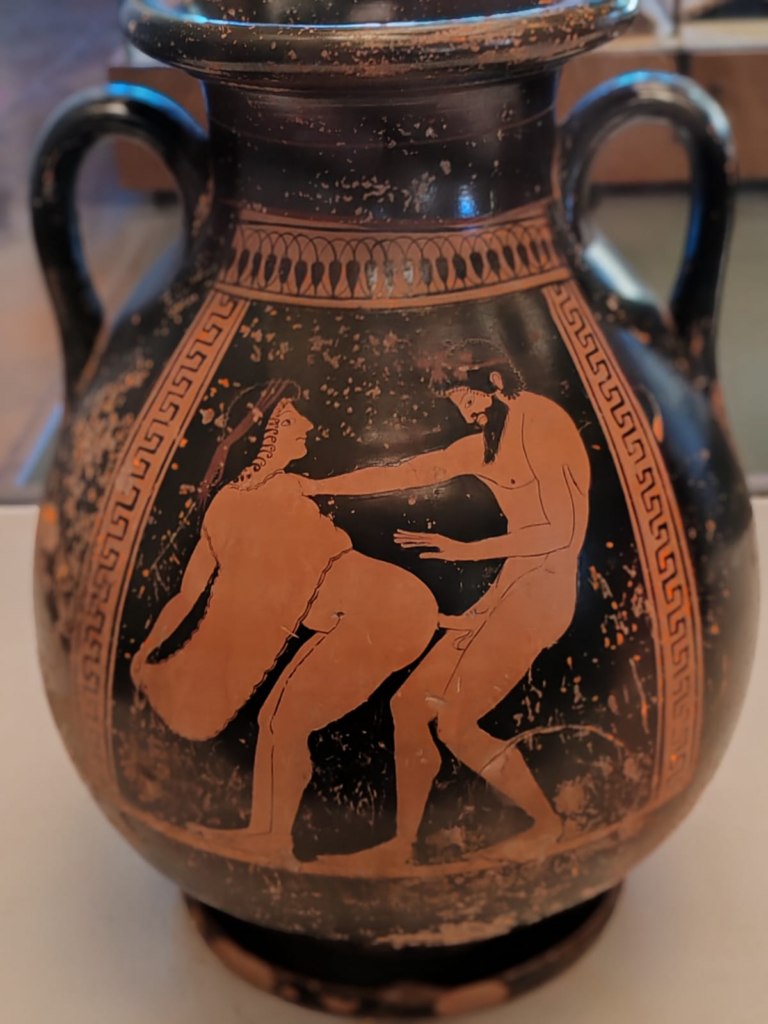
What makes these pieces even more fascinating is their journey. Although crafted in Greece, many of these vases were discovered inside Etruscan tombs in Tarquinia. Funerary arrangements in Etruscan society were often organized by the surviving partner or family members when a loved one died. The objects placed in the tomb were not random: they were chosen with care.
It is therefore moving to imagine that a vase bearing a particular image — perhaps one that had accompanied a couple during banquets or daily life — was selected precisely because it held personal meaning. The scene represented on the ceramic may have reflected intimacy, affection, shared experiences. In this sense, these erotic images were not simply decorative or symbolic in a general way; they may have been deeply connected to individual lives and relationships, and sometimes chosen as a final companion for eternity.
Perhaps the slight embarrassment we feel today says more about us than about them. For the Greeks — and for the Etruscans who treasured and buried these objects — the body was not separated from the sacred sphere. It was one of its expressions.
And this is something my job constantly reminds me: when studying history and ancient civilizations, we should never judge the past through the lens of our own modern mentality. To truly understand
these cultures, we must first try to see the world as they did — where eros was not the opposite of the sacred, but one of its oldest and most profound manifestations.